
Inside an Industrial Electrical Control Panel
Understanding the Components That Keep Industrial Automation Running
From manufacturing plants and wastewater facilities to renewable energy systems and commercial buildings, industrial electrical control panels serve as the command center for modern automation.
At first glance, a control panel may look like nothing more than an organized collection of wires and electrical devices. In reality, every component inside has a specific purpose—from safely distributing power to protecting equipment, controlling motors, and communicating with PLCs and HMIs.
Just as important as the electrical components themselves is the enclosure that protects them. A properly designed enclosure safeguards the system from dust, moisture, chemicals, impact, UV exposure, and temperature extremes while providing adequate space for wiring, cooling, and future expansion.
Let's take a closer look at the major components found inside a typical industrial control panel.
Main Incoming Protection
Molded Case Circuit Breaker (MCCB)
The MCCB is typically the first device after incoming power enters the enclosure.
Its responsibilities include:
- Main disconnect for servicing
- Overload protection
- Short-circuit protection
- Equipment isolation during maintenance
Unlike smaller breakers, MCCBs are designed to interrupt significantly higher fault currents and can often be adjusted for trip characteristics.
Power Distribution
Busbars
Rather than routing large conductors throughout the panel, copper or aluminum busbars distribute three-phase power efficiently.
Typical busbars include:
- Phase A (R)
- Phase B (Y)
- Phase C (B)
- Neutral
Properly designed busbar systems improve reliability, reduce voltage drop, simplify maintenance, and create a cleaner panel layout.
Motor Control
Contactors
Contactors act as electrically controlled switches.
They allow PLCs, pushbuttons, sensors, or relays to start and stop motors remotely without carrying the full motor current through the control circuit.
Applications include:
- Pumps
- Fans
- Compressors
- Conveyors
- Mixers
Overload Relays (OLR)
While the circuit breaker protects against catastrophic faults, the overload relay protects the motor itself.
It monitors motor current and trips if excessive current continues for too long, preventing:
- Motor overheating
- Damaged windings
- Premature motor failure
Direct-On-Line (DOL) Starter
A DOL starter combines:
- Contactor
- Overload relay
- Control circuitry
It starts the motor at full line voltage, making it a simple and economical solution for many industrial applications.
Variable Speed Control
Variable Frequency Drive (VFD)
Modern systems increasingly replace traditional starters with Variable Frequency Drives.
Benefits include:
- Adjustable motor speed
- Soft starting
- Lower inrush current
- Improved energy efficiency
- Better process control
- Reduced mechanical wear
VFDs also generate heat, making enclosure design and thermal management especially important.
Circuit Protection
Miniature Circuit Breakers (MCBs)
MCBs protect:
- Control circuits
- Auxiliary power
- Lighting
- Power supplies
- PLC circuits
Instead of shutting down an entire panel, MCBs isolate individual branch circuits when faults occur.
Measurement & Monitoring
Current Transformers (CTs)
Current Transformers safely reduce high current into a standardized measurement signal.
They provide data for:
- Energy monitoring
- Digital meters
- Protective relays
- Building management systems
- Power quality analysis
Control Components
Timer Relays
Timer relays introduce controlled delays into automation sequences.
Common uses include:
- Motor sequencing
- Pump alternation
- Delayed shutdown
- Conveyor timing
- Safety interlocks
Relay Modules
Relay modules provide electrical isolation between sensitive PLC outputs and higher-power devices.
They also simplify troubleshooting and replacement during maintenance.
Wiring Organization
Terminal Blocks
Terminal blocks create organized connection points between field devices and panel wiring.
Benefits include:
- Easier installation
- Faster troubleshooting
- Cleaner wiring
- Simplified maintenance
- Future expansion
Proper labeling of every terminal is essential for long-term serviceability.
Fused Terminal Blocks
These combine wiring termination with integrated circuit protection.
They protect individual devices while reducing wiring complexity inside the enclosure.
Control Power
Control Transformer
Many industrial panels receive 480V or 600V incoming power but operate control systems at much lower voltages.
A control transformer converts line voltage into safer control voltages such as:
- 120 VAC
- 48 VAC
- 24 VAC
This protects operators while supplying PLCs, relays, HMIs, sensors, and control devices.
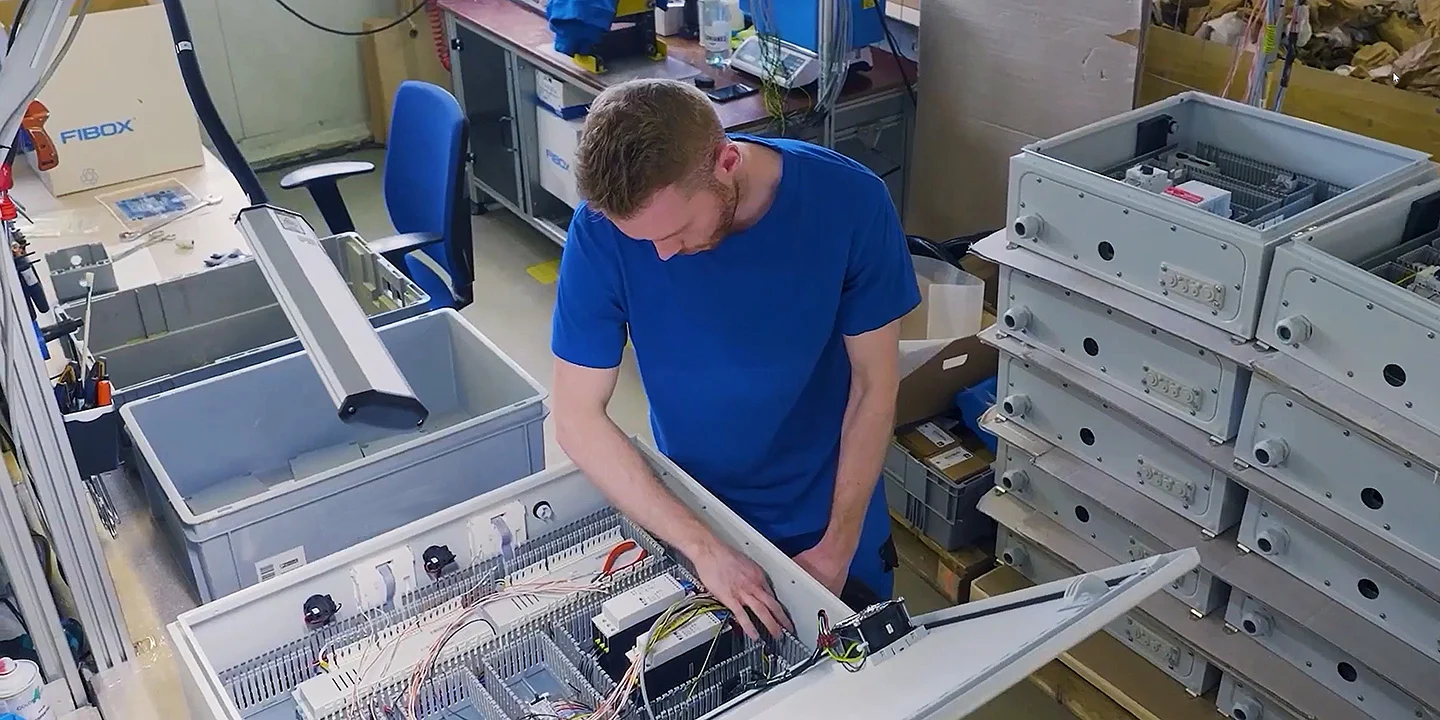
The Often-Overlooked Component: The Enclosure
Every component inside the panel depends on one critical piece of equipment—the enclosure itself.
A quality enclosure protects valuable electronics from environmental hazards while providing the structural foundation for the entire control system.
The enclosure should provide:
- Protection against dust and water ingress
- Corrosion resistance
- Impact resistance
- UV stability for outdoor installations
- Adequate mounting space
- Proper cable entry management
- Thermal management
- Room for future expansion
For non-metallic control panels, polycarbonate enclosures offer several advantages including corrosion resistance, electrical insulation, reduced weight, and excellent durability in harsh industrial environments.
Fibox Insight: Fibox polycarbonate enclosures are used worldwide for industrial control panels, PLC systems, VFD installations, motor control centers, and automation equipment. Their non-conductive construction, corrosion resistance, and high IP/NEMA ratings help protect sensitive electronics in demanding industrial environments without the maintenance concerns associated with painted steel.
Best Practices for Industrial Control Panel Design
A reliable control panel starts long before the first wire is terminated.
Design considerations include:
- Proper breaker coordination
- Correct conductor sizing
- Busbar spacing and insulation
- Wire duct capacity
- Component spacing for heat dissipation
- Ventilation or cooling when required
- Clear labeling and documentation
- Separation of power and control wiring
- Compliance with UL 508A and applicable electrical codes
- Allowance for maintenance access and future expansion
Common Causes of Control Panel Failure
Even well-built panels require periodic inspection.
Common maintenance issues include:
- Loose electrical connections
- Excessive heat buildup
- Failed relays or contactors
- Improper protection settings
- Moisture intrusion
- Corrosion
- Dirty ventilation filters
- Aging power supplies
Routine inspections, infrared thermal scanning, and preventive maintenance can significantly extend equipment life while reducing costly downtime.
Conclusion
An industrial control panel is far more than a box filled with electrical components. Every breaker, relay, drive, transformer, and terminal block plays a specific role in ensuring safe, reliable operation.
Equally important is selecting an enclosure engineered to protect those components throughout the life of the installation. By combining quality electrical design with a durable enclosure, engineers can improve reliability, simplify maintenance, reduce downtime, and extend the service life of critical equipment.
Whether you're designing a new automation system, upgrading an existing control cabinet, or specifying enclosures for harsh industrial environments, understanding how these components work together is the foundation of a reliable installation.
Need help selecting the right enclosure for your application? The Fibox technical team can assist with enclosure selection, sizing, environmental protection requirements, mounting options, machining services, and customization to help ensure your control panel performs reliably in even the most demanding environments.
Contact Fibox USA today to discuss your project or explore our complete line of industrial enclosure solutions.