
Outdoor Enclosure Selection: A Practical Engineering Guide
How Environmental Conditions Influence Enclosure Material Selection, System Reliability, Maintenance, and Lifecycle Cost
Outdoor electrical equipment is expected to operate reliably for decades despite exposure to sunlight, rain, temperature extremes, airborne contaminants, corrosive environments, and physical impacts. Whether protecting controls for a utility-scale solar installation, a wastewater treatment plant, a mining operation, an EV charging station, or an industrial automation system, selecting the appropriate enclosure is critical to long-term system performance.
Proper enclosure selection protects critical electrical equipment from environmental hazards while improving reliability, reducing maintenance requirements, and lowering total cost of ownership.
This guide provides a practical framework for evaluating environmental conditions and selecting enclosure materials for demanding outdoor applications.
Why Environmental Conditions Matter
The enclosure is the first line of defense for electrical and electronic equipment.
Unlike indoor control panels, outdoor enclosures must withstand years of environmental exposure while maintaining structural integrity and protecting sensitive electrical equipment. Selecting an enclosure based solely on initial purchase price can result in increased maintenance costs, reduced equipment life, and premature replacement.
Instead, enclosure material selection should be based on the environmental conditions the installation will experience throughout its service life.
Key Environmental Challenges
Ultraviolet (UV) Exposure
Long-term ultraviolet (UV) exposure can degrade non-UV-stabilized materials, reducing mechanical strength, weatherability, and service life.
Engineering Consideration
Specify UV-stabilized enclosure materials designed for long-term outdoor exposure.
Thermal Cycling
Daily heating and cooling cycles cause repeated expansion and contraction, placing stress on enclosure materials, seals, hinges, and mounting systems.
Engineering Consideration
Select enclosure materials and designs that maintain environmental protection throughout years of thermal cycling.
Moisture, Rain & Condensation
Rain, humidity, and condensation can compromise electrical equipment if the enclosure's environmental protection rating is not suited to the installation environment.
Engineering Consideration
Match the enclosure's NEMA and IP rating to the expected environmental conditions.
Dust & Airborne Contaminants
Wind-blown dust and airborne contaminants can reduce equipment reliability and increase maintenance requirements.
Engineering Consideration
Select enclosure designs that minimize contaminant ingress while maintaining long-term environmental protection.
Corrosive Environments
Salt spray, fertilizers, wastewater, and industrial pollutants can accelerate corrosion, reducing equipment reliability, increasing maintenance requirements, and shortening service life.
Engineering Consideration
Select enclosure materials that provide long-term corrosion resistance for the intended environment.
Mechanical Impact
Outdoor enclosures must withstand impacts during installation, maintenance, and normal operation while maintaining enclosure integrity and protecting sensitive electrical equipment.
Engineering Consideration
Consider impact-resistant enclosure materials for applications where accidental damage is possible.
A Practical Enclosure Selection Framework
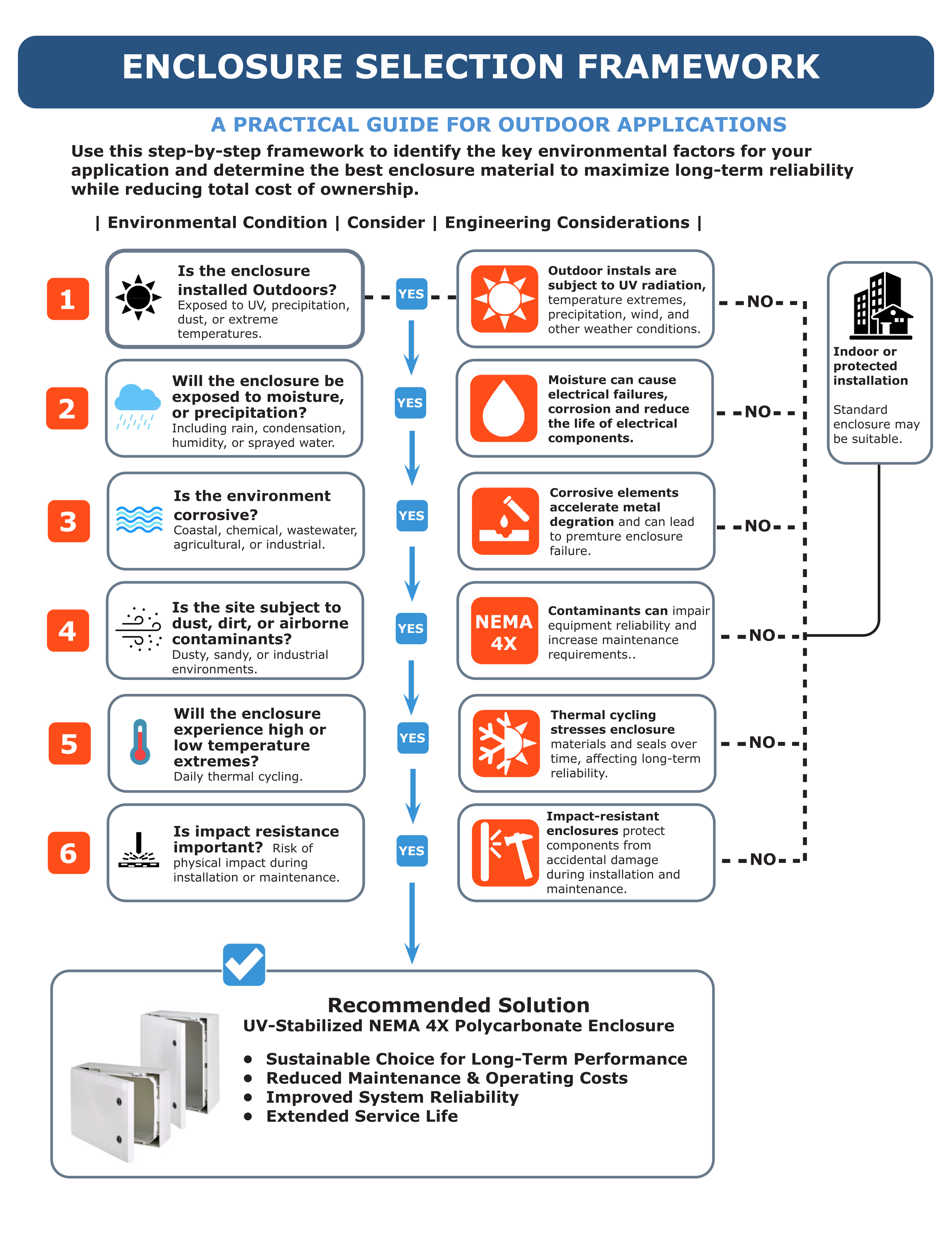
Before selecting an enclosure, evaluate the operating environment by asking the following questions:
- Is the enclosure installed outdoors?
- Will it be exposed to rain, washdown, or condensation?
- Is the environment corrosive?
- Will dust, dirt, or airborne contaminants be present?
- Will the enclosure experience high or low temperature extremes?
- Is impact resistance important?
Answering these questions early in the design process helps identify the appropriate enclosure material, environmental protection rating, and long-term maintenance requirements.
Material Selection Considerations
When comparing enclosure materials, engineers should evaluate:
- UV resistance
- Corrosion resistance
- Impact resistance
- Environmental protection (NEMA/IP)
- Weight
- Electrical insulation
- Thermal performance
- Ease of modification
- Maintenance requirements
- Total cost of ownership
Selecting the right material is often more important than selecting the least expensive enclosure. Among non-metallic options, the choice between ABS and polycarbonate usually comes down to UV exposure and operating temperature.
Common Outdoor Applications
The same enclosure selection principles apply across a wide range of industries and applications, including:
- Utility-Scale Solar Power Systems
- Battery Energy Storage Systems (BESS)
- EV Charging Infrastructure
- Water & Wastewater Treatment
- Oil & Gas
- Mining
- Industrial Automation
- Telecommunications
- Remote Monitoring & SCADA
- Utilities & Electrical Distribution
- Transportation Infrastructure
- Agriculture
Best Practices
- Specify UV-stabilized enclosure materials.
- Match the enclosure's NEMA/IP rating to the installation environment.
- Account for internal heat loads during system design.
- Design for safe and efficient maintenance access.
- Evaluate total cost of ownership—not just initial purchase price.
- Select corrosion-resistant materials appropriate for the installation environment.
Why Material Selection Matters
Outdoor enclosures are expected to protect critical electrical equipment for decades under some of the harshest operating conditions. While initial purchase price is often a consideration, maintenance requirements, environmental durability, and service life have a much greater impact on the overall cost of ownership.
Selecting the proper enclosure material at the beginning of a project helps reduce maintenance, improve equipment reliability, extend service life, and minimize costly downtime throughout the life of the installation.
Key Takeaways
- Environmental conditions—not initial cost—should drive enclosure selection.
- Proper material selection improves system reliability, reduces maintenance requirements, and lowers total cost of ownership.
- UV exposure, moisture, contaminants, corrosion, thermal cycling, and mechanical impact all influence long-term enclosure performance.
- Selecting the appropriate enclosure during the design phase helps improve reliability and reduce lifecycle costs across virtually every outdoor electrical application.
About Fibox
Fibox has been engineering high-performance non-metallic electrical enclosures for demanding industrial and outdoor applications for more than 50 years. Fibox UV-stabilized NEMA 4X polycarbonate enclosures are designed to provide long-term protection in environments where corrosion, moisture, impact, and environmental exposure challenge conventional enclosure materials.
Whether your application involves renewable energy, industrial automation, water and wastewater, mining, oil and gas, telecommunications, transportation, or critical infrastructure, selecting the right enclosure is an investment in long-term system reliability.