Practical, engineer-focused articles covering enclosure selection, panel design, environmental protection, industry standards, and installation best practices. Learn how to design more reliable electrical systems with expert guidance from Fibox.
The question is whether those modifications should be made in-house or supplied by the enclosure manufacturer or another outside partner.
There isn't one answer that works for every panel shop.
When In-House Machining Makes Sense
For panel builders with the right equipment and personnel, modifying enclosures internally can provide significant advantages.
It gives the shop direct control over scheduling and makes it easier to accommodate last-minute design changes. A one-off enclosure or prototype can potentially be modified immediately rather than waiting for an outside supplier.
Panel builders with CNC equipment and sufficient volume may also achieve very competitive modification costs.
In-house modification can be particularly attractive when:
The shop already has suitable machining equipment.
Modification is a core production capability.
Designs change frequently.
Quantities are small.
Very fast turnaround is required.
Engineering and production work closely together.
The enclosure material matters as well. Cutting and drilling steel, stainless steel, fiberglass, aluminum, and thermoplastics require different tooling, processes, and safety considerations.
When Pre-Machined Enclosures Make Sense
Outsourcing modification becomes more attractive when the same enclosure design is being produced repeatedly.
Once the machining program has been established, a supplier can potentially provide dozens or hundreds of enclosures with identical holes and cutouts.
That can free panel-shop employees to concentrate on wiring, component installation, testing, and other higher-value operations.
It can also reduce the possibility of losing an enclosure because a hole was drilled in the wrong location.
Don't Compare Enclosure Price Alone
A useful comparison is not simply the price of an empty enclosure versus a modified one.
Cost of an enclosure delivered ready for component installation.
For some panel builders, the first equation will win. For others, the second will.
A Hybrid Approach May Be Best
It doesn't have to be an all-or-nothing decision.
A panel builder might outsource repeat production while keeping prototype and emergency modifications in-house. Another might outsource complex HMI openings while drilling simple cable-gland holes internally.
The right approach depends on equipment, labor availability, volume, lead time, material, and how frequently the design changes.
Don’t Just Design a Control Panel to Fit — Design It to Be Serviced
Getting every component into an electrical enclosure is only part of good panel design.
Eventually, someone will have to build it, troubleshoot it, maintain it, or modify it.
A technician may need to replace a power supply, tighten a terminal, trace wiring, access a PLC, change a fuse, or add equipment years after the panel was originally installed. A layout that looks efficient on a CAD drawing can become frustrating in the field if routine work requires removing unrelated components simply to reach the device that needs attention.
Good panel design should therefore consider not only whether everything fits, but also how easily people can work on it.
Leave Room for People, Not Just Components
Component dimensions tell you whether something physically fits. They don't necessarily tell you whether someone can install, wire, or service it.
Panel builders should consider:
Space around terminals and connectors
Screwdriver and tool access
Wire bend radius
Wire duct access
Component removal paths
DIN rail spacing
Door- or cover-mounted equipment
Connector locations
Access to mounting hardware
Packing components tightly can reduce the enclosure size and potentially lower cost. But there is a point at which those savings can be offset by additional assembly, troubleshooting, and service time.
A few inches of additional space can sometimes be more valuable than a smaller enclosure.
Think About What Will Need to Be Serviced
Not every component requires the same level of accessibility.
Fuses, relays, power supplies, batteries, filters, terminal blocks, and other serviceable components may deserve more accessible positions than equipment that is unlikely to be touched during the life of the panel.
Frequently serviced components should ideally not be located behind equipment that must first be removed.
The same thinking applies to connections. A component may be easy to see but difficult to service if its terminals are inaccessible once neighboring components and wiring are installed.
Consider How the Panel Is Built
Serviceability and assembly efficiency can begin before the panel ever reaches the field.
Traditional fixed mounting plates work perfectly well for many control panels. But depending on the enclosure design, removable or adjustable mounting systems can provide another option.
For example, some adjustable-depth mounting kits allow the mounting plate to be assembled and wired outside the enclosure and then slid into the enclosure base.
That can give panel builders much better access to components and wiring during assembly because technicians aren't constantly reaching into the enclosure.
Once the panel is assembled, the mounting plate can be installed and positioned at the appropriate depth.
This approach won't provide a meaningful advantage for every build. But on more complex panels, repetitive production, or applications with difficult component access, the ability to work on the panel outside the enclosure can simplify assembly.
Make Use of Adjustable Depth
Adjustable-depth mounting can also help solve clearance problems.
Instead of having one predetermined mounting-plate position, the panel can potentially be moved forward or backward within the available enclosure depth.
That can help accommodate:
Deeper components
Door-mounted controls
HMIs and displays
Wiring and connectors
Cable-entry requirements
Components of different heights
The goal isn't simply to maximize depth. It's to put the mounting surface where it makes the most sense for the particular design.
Consider Visibility
Sometimes the easiest equipment to service is equipment that doesn't have to be accessed in the first place.
Where appropriate, windows or transparent covers can allow technicians to see displays, meters, status indicators, and warning lights without opening the enclosure.
This can be useful for routine inspection and troubleshooting, although whether a transparent cover or window makes sense depends on the equipment, environment, security requirements, and application.
Leave Some Room for Tomorrow
Control panels have a habit of changing.
A customer may eventually want another sensor, communications device, terminal block, relay, or power supply.
That doesn't mean every enclosure should be substantially oversized. Larger enclosures cost more, occupy more space, and can increase shipping and installation costs.
But leaving reasonable expansion space can prevent a relatively minor future change from requiring a major redesign.
Think About Where the Finished Panel Will Be Installed
An enclosure mounted comfortably at eye level inside a factory is very different from one mounted on a pole, beneath equipment, beside a pump, or outdoors in a confined area.
Panel builders should consider:
Door or cover swing
Hinge orientation
Mounting height
Nearby equipment or structures
Access to fasteners
Ability to remove the mounting plate
Space available for technicians and tools
These issues can be easy to overlook when designing a panel on a screen or assembling it on a bench.
Design for the Person Who Comes After You
A successful panel design shouldn't only answer:
“Can we fit everything inside?”
It should also answer:
“Can we build it efficiently, and can somebody work on it five years from now?”
Thinking about accessibility, mounting depth, wiring, component replacement, and future changes during the initial design can make the finished panel easier to assemble and easier to maintain throughout its service life.
Working on a new panel design? Fibox offers fixed and adjustable-depth mounting options for selected enclosure systems, including configurations that allow a panel to be assembled outside the enclosure before installation. Talk to Fibox About Your Application
Is Polycarbonate a Metal? Understanding This Engineering Plastic
Quick answer
No. Polycarbonate is a thermoplastic polymer, not a metal. It is used for electrical enclosures because it combines high impact toughness, low weight, electrical insulation and corrosion resistance. Depending on the application, those properties can make it a practical alternative to steel, stainless steel, aluminum or fiberglass.
What is polycarbonate?
Polycarbonate is an engineered plastic whose molecular structure includes carbonate groups. It can be molded into complex, repeatable shapes and produced in opaque or transparent grades. Manufacturers can tailor formulations for ultraviolet exposure, flame performance, color, impact behavior and other requirements.
Why does it sometimes feel like a metal replacement?
A molded polycarbonate enclosure can perform many of the same protective functions as a fabricated metal box: it houses electrical and electronic components, limits access to hazardous parts and protects equipment from environmental exposure. It is therefore often compared with metal, even though its physical and electrical properties are very different.
Polycarbonate does not rust
Because polycarbonate contains no iron, it cannot rust. It can still be affected by incompatible chemicals, ultraviolet exposure if the wrong grade is used, excessive heat or poor mechanical design. “Corrosion resistant” should therefore be understood in relation to the specified environment, not as a promise that every plastic tolerates every chemical.
Polycarbonate is electrically insulating
Unlike steel or aluminum, polycarbonate does not conduct electricity under normal enclosure-use conditions. This can reduce certain grounding and bonding concerns associated with a conductive housing, although the finished electrical system must still comply with all applicable wiring, grounding and safety requirements.
Is it as rigid as metal?
No. Polycarbonate has lower stiffness and tensile strength than steel. It will flex more under load. In many enclosure applications, that controlled flexibility is useful because it can absorb impact and recover instead of denting or cracking. In applications dominated by structural loads or extreme rigidity, metal may be the better choice.
Polycarbonate versus fiberglass
Both are nonmetallic and corrosion resistant, but they behave differently. Polycarbonate is a thermoplastic; typical fiberglass enclosures use a thermoset resin reinforced with glass fibers. Polycarbonate can provide a smoother surface, cleaner machining and strong impact performance. Fiberglass can offer stiffness and chemical resistance in certain environments, but machining may expose fibers and damaged areas can crack rather than flex.
Where polycarbonate enclosures are used
Common applications include industrial automation, water and wastewater controls, renewable-energy equipment, telecommunications, monitoring systems, machine controls, building systems and outdoor junction boxes. UV-stabilized grades and suitable NEMA or IP ratings are important when the enclosure will face sun, rain, washdown, dust or temporary submersion.
How to Prevent Condensation in Electrical Enclosures
Prevent condensation by keeping internal surfaces above the dew point, limiting humid-air entry and giving trapped moisture a controlled way to escape. Depending on the application, that may require an enclosure heater with a hygrostat, correctly designed ventilation or cooling, a pressure-equalization vent, sound gaskets and cable glands, and careful enclosure placement.
Why a sealed enclosure can still develop condensation
Condensation does not always mean rainwater leaked through the cover. Moist air can enter during assembly or maintenance, migrate through imperfect seals, or be drawn through small openings as temperature changes create pressure differences. When that air touches a surface colder than its dew point, water vapor becomes liquid—even inside a high-rated enclosure.
Common warning signs
Look for droplets on the cover or walls, water collected at the bottom, fogging beneath a transparent cover, corroded terminals, discolored copper, intermittent faults and repeated nuisance trips. These symptoms should trigger an inspection before corrosion or a short circuit causes a larger failure.
1. Control the temperature
A small enclosure heater can keep the interior and its components above the dew point. Pairing it with a hygrostat or suitable controller allows heat to operate when humidity or temperature conditions create risk. Heater sizing and placement matter: allow circulation, maintain component clearances and avoid creating local hot spots.
2. Manage heat without pulling in wet or dirty air
Ventilation can reduce internal temperature, but open-filter systems exchange air with the environment. In humid, dusty or corrosive locations, that tradeoff may be unacceptable. If active cooling is required, choose a system appropriate for a sealed enclosure and manage condensate so it cannot drip onto components. A thermal calculation should account for component heat load, enclosure material and size, ambient temperature, solar gain and required internal temperature.
3. Equalize pressure
Daily heating and cooling cycles change the air pressure inside an enclosure. A partial vacuum can pull humid air through microscopic gaps around the cover, glands or hardware. A properly rated membrane vent can equalize pressure while restricting liquid water and contaminants. Select the vent for the required airflow and enclosure rating, and install it according to the manufacturer’s instructions.
4. Inspect every seal and opening
Check the cover gasket for damage, compression set, dirt and discontinuities. Verify that cable glands fit the cable diameter and are tightened correctly. Seal unused openings with rated plugs. Inspect hinges, latches, windows and field-cut holes. The complete assembly—not the empty box alone—determines whether the installation maintains its intended environmental protection.
5. Reduce moisture introduced during installation
Avoid leaving the enclosure open in rain, fog or very humid conditions. Dry the enclosure and components before closing it. Route cables so water does not track along them toward glands, and use drip loops where appropriate. Do not trap wet packaging, cleaning residue or condensation inside during commissioning.
6. Choose placement carefully
Avoid mounting directly above steam sources or where roof runoff, sprinklers or process spray repeatedly hit the enclosure. Shielding can reduce solar gain and rapid temperature swings, but it must not block ventilation or access. Mounting orientation should follow the enclosure and accessory instructions.
Should you drill a drain hole?
Do not improvise a drain hole in a NEMA 4X or 6P enclosure. An unapproved opening may compromise the rating and allow contaminants to enter. Some enclosure types, such as certain Type 3R designs, intentionally use drainage, but that is part of their design. For a sealed assembly, use tested accessories and an engineered condensation-control plan.
Condensation-prevention checklist
Identify temperature and humidity extremes; calculate the thermal load; determine the dew-point risk; choose heating, cooling or controlled ventilation; add pressure equalization if appropriate; specify rated glands and accessories; inspect seals after machining and assembly; and include condensation checks in preventive maintenance.
Need Help?
Fibox can help evaluate enclosure size, material, rating, accessories and thermal-management needs for wet or rapidly changing environments.
No—polycarbonate is not stronger than steel in absolute tensile strength or stiffness. Steel carries higher structural loads and resists deformation better. But an enclosure does not succeed on tensile strength alone. Polycarbonate can be the more durable choice where impact recovery, corrosion resistance, electrical insulation, low weight and easy modification matter.
Why “stronger” is misleading
Material strength can refer to tensile strength, stiffness, impact resistance, puncture resistance, fatigue, environmental durability or the performance of a finished part. A steel coupon will generally outperform a polycarbonate coupon in tensile strength and elastic modulus. That does not automatically predict which finished enclosure will last longer in a corrosive wastewater plant, a solar field or a coastal installation.
Polycarbonate bends before it breaks
High-quality polycarbonate is tough and ductile. Under an impact or installation load, it can flex, spread the force and recover. That behavior can look less rigid than metal, but flexibility is not the same as weakness. It may prevent cracking or permanent denting when cables, tools or moving equipment apply a sudden load.
Where steel wins
Steel is the appropriate choice when very high stiffness, structural load capacity, shielding, fire-performance requirements dominate the specification. It can also provide a familiar platform for very large freestanding cabinets. The correct grade, thickness, coating and bonding method must be selected for the environment.
At-a-glance comparison
Property
Polycarbonate
Steel
Tensile strength and stiffness
Lower
Higher
Impact behavior
Tough; can flex and recover
Strong but may dent or permanently deform
Corrosion
Does not rust
Requires material or coating selection
Electrical conductivity
Insulating
Conductive
Weight
Light
Heavier
Field modification
Easy with standard tools
May require heavier tooling and edge treatment
Where polycarbonate can outperform
Polycarbonate does not rust, needs no paint layer to provide basic corrosion resistance and is electrically insulating. It is much lighter than steel, which can reduce lifting effort and support requirements. It is also easier to machine without exposing bare metal that then needs edge protection. These advantages can reduce installation time and maintenance in wet, salty or chemically aggressive locations.
Impact resistance is a system property
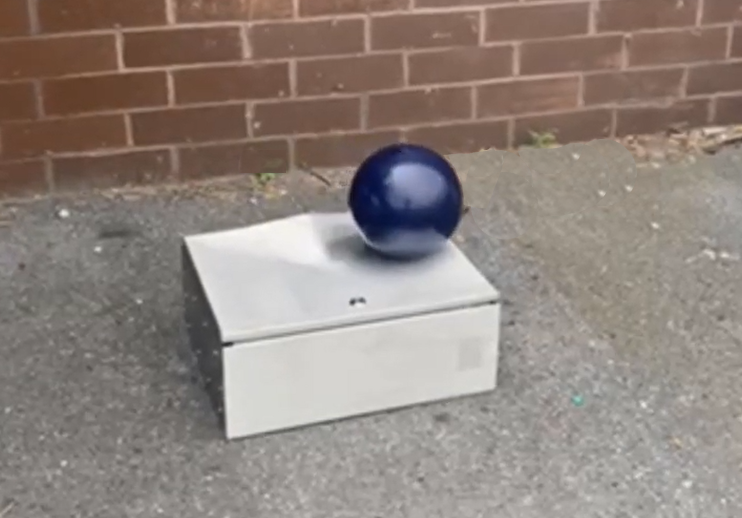
Wall thickness, ribs, corners, cover geometry, mounting method, temperature and the location of cutouts all affect impact performance. A large hole positioned too close to an edge can weaken any enclosure. Compare complete products using certified ratings and relevant test data rather than comparing generic material claims alone. Watch the video to see how well metal holds up.
What about outdoor exposure?
Outdoor polycarbonate should be formulated and certified for ultraviolet exposure. UV-resistant grades help preserve mechanical properties and appearance. Steel also needs the correct coating or alloy for outdoor service; scratches, cut edges and chemical exposure can initiate corrosion. Neither material should be specified without considering the actual environment.
How to choose
Choose steel when maximum rigidity or structural capacity is the controlling requirement. Choose a UV-stabilized polycarbonate enclosure when impact toughness, corrosion resistance, electrical insulation, lower weight and installation efficiency offer greater lifecycle value. If the application combines unusual loads and chemicals, request application-specific test data and validate the completed assembly.
Fibox perspective
Fibox polycarbonate enclosures are designed as engineered housings, not simply plastic substitutes for metal boxes. Features such as reinforced walls, molded bosses, durable gaskets and NEMA Type certifications allow the finished enclosure to use polycarbonate’s flexibility and corrosion resistance as practical strengths.
Finding water droplets inside an electrical enclosure can be alarming. Many people assume the enclosure is leaking, but in many cases the moisture never entered from the outside—it formed inside the enclosure.
Understanding why condensation occurs is the first step toward protecting sensitive electronics and improving long-term system reliability.